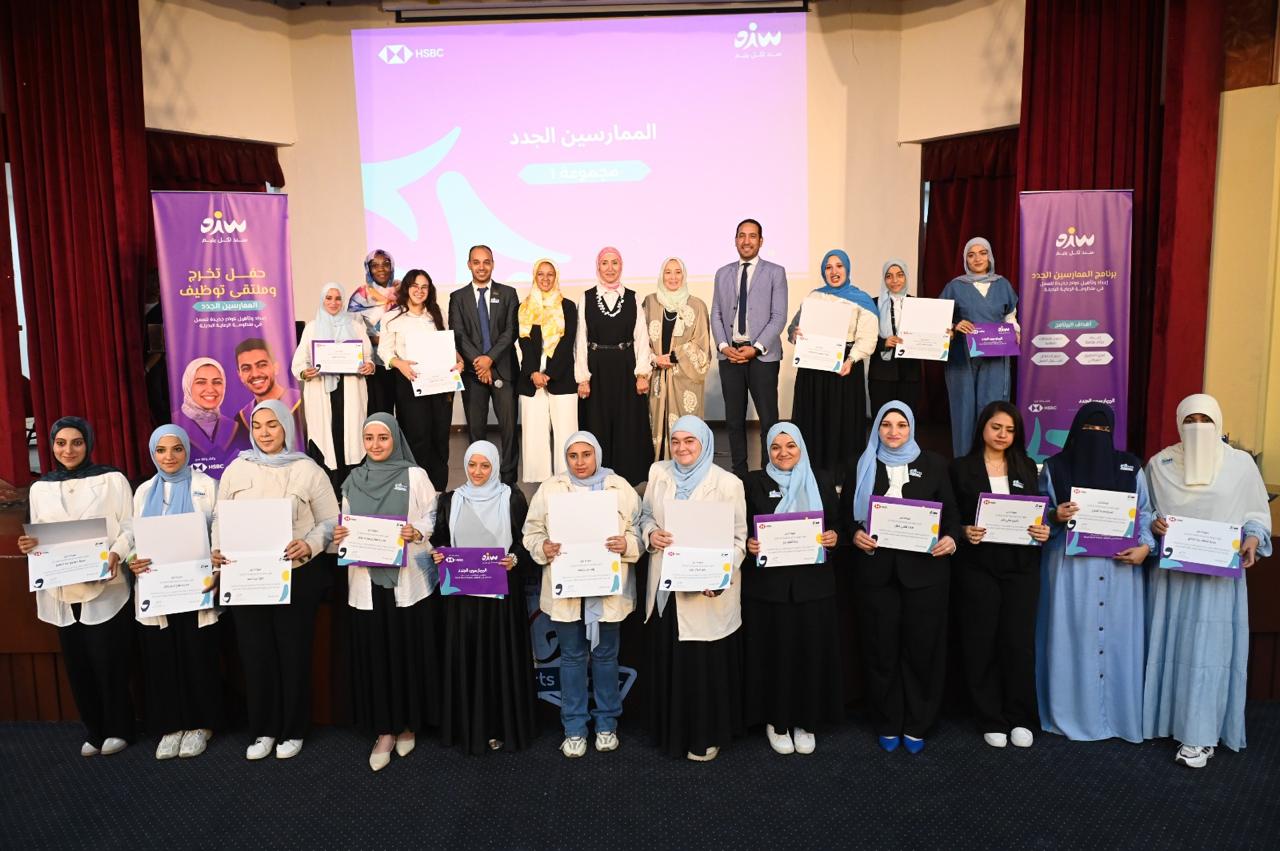
The “Sanad Association for Alternative Parental Care” organized a graduation ceremony and a recruitment forum for new practitioners as part of the project titled “Preparing and Qualifying New Practitioners within the Alternative Care System.” Held at the Olympic Center for National Teams in Maadi, this event—the first of its kind in the field—was organized in collaboration with the Ministry of Social Solidarity, the private sector, the Capital University, and 6th of October University.
The ceremony marked the graduation of 93 students who had completed a comprehensive year-long training program. This program combined theoretical instruction with practical application, equipping them to launch their careers in alternative care and contribute to supporting children deprived of parental care.
The “New Practitioners” program aims to prepare and qualify new personnel for the alternative care system, develop participants’ professional skills, enhance practical and field-based experience, and facilitate the graduates’ transition into the labor market.
The event also featured a recruitment forum that brought graduates together with 15 institutions and entities active in the alternative care sector, as well as universities and partners. This provided opportunities for networking, exchanging expertise, exploring employment and collaboration prospects, and aligning the graduates’ qualifications with labor market needs. Azza Abdel Hamid, founder and president of the “Sanad” Association, expressed her delight at the graduation of a new cohort of alternative care practitioners. She voiced her pride in the graduates and extended her gratitude to the Ministry of Social Solidarity, universities, and partners for their support of the association’s programs since its inception.
Abdel Hamid stated that the graduates now face a significant responsibility: serving orphaned children and providing the necessary care and support to help build a better future for them.
For her part, Yasmine El-Hagry, Executive Director of “Sanad,” said that the association’s core vision is for every child to be capable of shaping their own future, noting that the association works toward this goal through a set of integrated approaches.
She explained that “Sanad” works to enhance quality standards in alternative care, implement accredited professional training programs, and raise awareness while generating knowledge in the field.
El-Hagry noted that it is time to view the alternative care sector not merely through the lens of development or charity work, but through that of the “care economy.” She explained that by qualifying caregivers and providing professionals capable of empowering children and youth who lack parental care, a productive generation can be fostered—one that spares the state the costs associated with psychological treatment, family breakdown, violence, crime, and unemployment. For her part, Prof. Dr. Safaa Khodeir, Vice Dean for Community Service and Environmental Development at the Faculty of Social Work, Capital University, stated that the Sanad Association and Capital University are preparing to sign a cooperation protocol to launch a specialized professional master’s program in alternative care. Accredited by the Supreme Council of Universities, this program is the first of its kind in Egypt in this field.
Between 2021 and 2025, the “New Practitioners” program made a tangible impact on preparing and qualifying personnel for the alternative care system, benefiting 429 students.
The Association is preparing to launch a new cohort of the program targeting 250 trainees. Efforts are underway to introduce new specialized tracks aligned with labor market needs and existing gaps, and to refine training content based on feedback and lessons learned from previous cohorts.
The upcoming phase also aims to expand training partnerships to provide greater opportunities for practical and field training and to strengthen the link between training and the labor market. This supports the trainees’ transition from learning to practice and prepares them for careers in the alternative care sector.